Sunday, February 21, 2016

Causal Inference Resources

I was inspired by the post "Why you should stop worrying about deep learning and deepen your understanding of causality instead" to write up some of the resources I've used over the past year as I myself have tried to learn more about causality.

The field of Causal Inference has become much more rich and interesting over the past 20 years as a number of new statistical tools were created to help improve the bias inherent in model dependent statistical inference. I find it's best to start with understanding the split between prediction and causal inference that has been in the field for quite a while. Each of the following three references goes into much more detail about how many of the same tools are used between causal inference and prediction, but the meaning assigned to the model, and in particular how you evaluate the model for appropriateness is very different depending on what you're trying to do.
 
Statistical Modeling: The Two Cultures : http://projecteuclid.org/download/pdf_1/euclid.ss/1009213726
 
My team and I spent a lot of time dealing with observational data. Therefore much of my focus has been about how to make better decisions when dealing with observational data and quasiexperimental study design. There's been a lot of research in this area because so many medical studies are based on observational data. The Evidence Based Medicine movement came out of a desire to improve clinical decision-making outcomes and provides many ideas that can be reused within my own field. One of the pieces that is fantastic for decision-making in general, is the hierarchy of evidence. This provides a framework within which to base your decision making and understand how biased your study could possibly be.
 
One of the articles I really enjoyed coming across was by Rubin: "For objective causal inference, design trumps analysis". In it he briefly covers the counterfactual framework, and reworks an observational study through the lens of experimental design, using the appropriate tools to approximate a true experiment to the best of his ability. It definitely gave me a much better understanding about the role of treatment assignment and how it participates and causal inference.
 
And now onto books!
 
The first book is particularly awesome and mathy. I find that it hops right in and covers the key concepts you need to understand about modern causal inference theory. That is both a strength, and weakness. If you're not up to date on reading mathematical notation, it can be a little challenging.

"Counterfactuals and Causal Inference" by Morgan and Winship
This was the first book I got. I actually had the first edition, and upgraded to the second edition when it came out, definitely worth it. I found many of the topics more approachable in this book than the previous book, but they restrict the set of tools they give you. Therefore I found it a great place to start and become comfortable with counterfactual theory and causal diagrams, but I eventually had to upgrade to the book out of the Harvard school of public health.
 
Many papers you encounter will refer back to the work in this book, which is largely a compendium of the research done by Rubin. I found it an additional perspective to many of the concepts covered in the previous two books. So probably not required, but nice to round things out.
 
This book showed me how little I really knew. It was the last one I purchased and I still haven't finished it. I really need to sit down and compare the contents of this textbook against the second half (Model Dependent Causal Inference) of the Causal Inference book out of Harvard.
 
OK. This book hasn't shipped, and I haven't read it. But I'm very excited by it. Judea Pearl's other book: "Causality: Models, Reasoning and Inference" is well-regarded, but also known to be very difficult as it connects together causal reasoning in several different fields into one overarching framework. He also has a blog we can stay up-to-date on some of the latest books and research in this area: http://causality.cs.ucla.edu/blog/index.php/2016/02/12/winter-greeting-from-the-ucla-causality-blog-2/ .
 
Lastly, one of the early papers I encountered that I felt did a good job in this area: Sekhon, J. S. (2011). Multivariate and propensity score matching software with automated balance optimization: The Matching package for R. Journal of Statistical Software 42(7). http://www.jstatsoft.org/v42/i07 . I found his package rather straightforward to use and high enough performance to work against the large data sets I deal with on a regular basis.
 
If you're ever in the Seattle area and want to chat about these things, I would love to do coffee.
 
--chris


Saturday, March 22, 2014

Date Based Cohort Analysis for Adobe SiteCatalyst using R

Over the years I've generally avoided Excel. Being a programmer, I could just pick up python and write code to do what I needed, I didn't need to hack something together in Excel. But I always ended up back there for the charting.

Then I learned R and have even more reason to avoid Excel.

Recently I needed to implement date based cohorts in SiteCatalyst. While there are a few blog posts on how to do this in Excel using Report Builder (http://adam.webanalyticsdemystified.com/2013/03/07/conducting-cohort-analysis-with-adobe-sitecatalyst/ , http://blogs.adobe.com/digitalmarketing/mobile/what-is-mobile-cohort-analysis-and-why-should-you-use-it/) they didn't work for me. My team is all on MacOS, and Report Builder isn't.

In this example I'm going to use events tracked by the Mobile Library lifecycle stats. One plus of this solution is it doesn't require any SAINT classifiers to convert mobileinstalldate to a month/year.

The idea here is you use QueueTrended to chunk together uniqueusers by month, with mobileinstalldate as the counted event. If you look at the data output from QueueTrended is makes more sense. The rest is then using plyr and reshape2 to beat the data into the form we want. It works just fine with segments.

I'm not sharing my code that generates percentages yet because I'm not particularly happy with it yet. Drop me a line if you are interested.

And yes, the data is small, this is from a private unreleased product I am working on.

Saturday, October 5, 2013

The Lean Startup Movement from a Decision Science perspective

First off, my apologies to actual Decision Scientists. I have no formal training and just recently learned that the area I'm fascinated by actually has a name.

There are a lot of anecdotes out there about how wonderful all the different Lean Startup methodologies are. If you go and read the Amazon book reviews, you'll see lots of comments about how it changed someones life. 

What you won't see is any data showing they actually help.

I'm a skeptic at heart. Studies on businesses are notoriously difficult to do, and while I could see value in the tools and techniques, I really wanted a deeper scientific basis for all the hype.

I finally managed to find it within the Decision Science literature. Daniel Kahneman has done a great survey of key ideas and concepts in "Thinking, Fast and Slow". It's a long book, but for the purposes of this discussion we really care about part 3: Overconfidence. "The Signal and the Noise" by Nate Silver also talks a fair amount about our inability to do forecasts well. Lastly, "Naked Statistics" provides another view.

The Lean Startup Methodologies (LSM) are designed to help you answer two questions:
1) Should I even bother building a full product?
2) If I do build the product, should I continue with incremental changes, or pitch the whole thing and start over?

As an entrepreneur with a product or business idea you are going be subject to three different cognitive illusions. These are things that are common to all of humanity, and there is little you can do to train them away. The three illusions I see as being the most problematic are Optimism Bias, Domain Expertise Confidence; Confidence in Prediction in an unstable environment.

Optimism Bias
Humans in general tend to think they perform better then average. In particular, entrepreneurs tend to be even more optimistic then the general population about their ability to beat the odds. For instance the base rate of failure for a new business is 65%. But the vast bulk of entrepreneurs consider their chance of failure at 40%. This delusion can help us make it through the day, but it can also cause you to stick with something for far too long. (Kahneman, Daniel (2011-10-25). Thinking, Fast and Slow (p. 256). Farrar, Straus and Giroux. Kindle Edition. )     

Domain Expert Overconfidence
Everyone is over-confident about their ability to predict the future. Doesn't matter how much of an expert you are in your field, you are overconfident. Time and time again we see research that shows a crappy mathematical model that is informed by expert opinion is almost always better than either one alone. (http://www.rff.org/Events/Documents/Lin_Bier.pdf, all of "The Signal and the Noise").

The second part here is apropos to a problem I'm wrangling with at work. I'm working on a product that is all about market creation. By definition, my ability to research and learn about my market is terribly limited since the market doesn't exist. Learning the Lean Startup tools improves your metacognitive ability to see your own weakness in expertise and therefore adapt to it. (http://gagne.homedns.org/~tgagne/contrib/unskilled.html)

Confidence of Prediction
When you ask yourself "Do I need this feature in my product?", the question you are really asking is "Will adding this feature to my product add enough value to my business in the future to justify the (opportunity) cost now?". That is attempting to forecast the future, something humans can be good or bad at depending on how quickly they get feedback about their decisions. Firefighters and nurses, who get almost instantaneous feedback on the quality of their forecasting are able to build a great amount of skill in this area. Those of us running in longer time scales fall prey to building confidence in our predictions, but not actually improving our accuracy. Think of how much that sucks for a moment. You can be in a field for years, making forecasts, assuming you are getting better, but in reality, you aren't. (Kahneman, Daniel (2011-10-25). Thinking, Fast and Slow (p. 240). Farrar, Straus and Giroux. Kindle Edition.)

Essentially it all boils down to the fact that you are going to feel really confident about your idea and plans, but that confidence is not based on actual hard data. It is instead an illusion being fed on how we perceive and think about the world. You can't use your gut 'Confidence' check to know if you really have a product or not at the get go, we're just not wired that way.

But by acknowledging our limitations, we can figure out ways to work around them.

So how do you deal with this trifecta of Overconfidence in your idea?

To quote Steve Blank: "GET OUT OF THE BUILDING" and go talk to customers.

That's it.

All the different LSM out there have different suggestions on how to go about defining a market segment, finding customers, and how to talk to them. But it boils down to talking directly to customers to counteract your overconfidence. They all reccomend a progressive approach in how you do your research. You start with wide open investigational interviews, and as you learn more (and validate or invalidate your overconfident beliefs) you start using more structured interviews to gather more accurate data (but less wide ranging) including things like surveys and prototypes. You can even run A/B value prop testing with a mock web site and google adwords.

That said, you need to be cautious about over-generalizing your results. We humans love to see patterns and over value things we see and measure, even if they have low confidence.
 (Patrick Leach (2006-09-15). Why Can't You Just Give Me The Number? (Kindle Locations 1911). Probabilistic. Kindle Edition. )

Launching - Answering the "Persevere or Pivot" question

These pre-launch experiments have a whole range of cost, accuracy, and specificity. On the low end you have informal unstructured interviews. This is great for proving things our early on, and also allowing you to find a better business idea then the one you thought of originally. On the high end of cost and complexity, you have large scale polling that you do right (i.e. random distribution of customers, proper question wording to avoid bias, etc). These aren't going to find you that better business idea, but can provide a very accurate and specific answer to the question you pose. 

At some point though (and this will be very specific to you and your circumstances) you'll need to sit back and decide to stop pre-launch experments. When do you stop? When failing in market will be better then continuing to run experiments. For example, if you have a large existing business (lets say $100M in annual revenue) that you are thinking of disrupting with a new revenue model, you probably want to do the more formal methods since spending $50,000 on a polling firm and taking the time is small relative to the risk. But a 6 person startup with no actual revenue yet? Depends on the size of your market. If you only have 100 customers, you may want to do more upfront work because running experiments on customers can cause them to get grumpy and leave. But if you have a larger target market, it's fine to lose some customers while you work things out. If you are looking for a more decision science based approach, see Chapters 11 and 12 in Patrick Leach (2006-09-15). Why Can't You Just Give Me The Number?. The different market sizes account for the different approaches in the LSM books.

Once you get a product in market, you are still subject to the same overconfidence illusions around forecasting. This is where the second part of the LSM stuff kicks in: Analytics and Rapid iteration.

I'm totally thrilled to watch market after market get disrupted by rapid prototyping. On the hardware side we had FPGA's come along in the 90's that allowed really interesting products to be built without the capital outlay needed for an ASIC. On the SaaS side, AWS/DevOps/Harware as software movement has added nimbless to that field. Outside of computing, the revolution around rapid prototyping, 3D printing, and cheap CNC tools (like CNC plywood routers) has drastically changed things. Even the repatriation of hard goods manufacturing is occuring because it allows businesses to iterate faster (http://www.nytimes.com/2011/10/13/business/smallbusiness/bringing-manufacturing-back-to-the-united-states.html?pagewanted=all ). 

How can overconfidence get you after launch? Go read the opening chapters of "The Startup Owners Manual" to learn about how Webvan's overconfidence caused them to ignore the metrics they were getting and fail big.

The steps at this point are:
1) Ship iteration of business (this includes ad copy, market segment, marketing webite and materials, actual product)
2) Observe behavior using quantitative metrics
3) Use that to drive qualitative discussions with customers
4) Make a hypothesis and modify product/web site/ad copy
5) Repeat

It's easy to get analytics wrong. Eric Ries labeled these 'Vanity Metrics'. These are metrics that are pretty much guaranteed to give you the answer you want (generally up and to the right). But much like qualitative interviews, there is a broad spectrum of accuracy and complexity around implementation. For that first launch you don't need much. Just a retention chart that is keyed off the activity that drives your engine of growth is enough to shake your confidence. You are looking for analytics that help you detect the huge problems in your overconfident assumptions. You aren't at the point where you care about 3% improvement in a number or running a linear regression on your data.

Don't know what metrics to track? Grab a copy of Lean Analytics (http://leananalyticsbook.com/). They breakdown a large number of different business models and what you should be looking at to decide if you should throw in the towel or not.

How quick should your iterations be? As quick as possible without pissing off your customers or partners. For instance, if you are growing rapidly you should iterate quickly (daily even?). As a portion of your customer base, those people irritated by all the change will always be a shrinking proportion of your total base since you are getting new customers at a very fast rate. I personally (overconfidentaly and untested of course) think you need to be willing to lose your early customers and therefore shouldn't worry about them.

One last moment of reflection. These are all really cool tools. But if you've already decided on a course of action, the value of any new information may be zero since it will not change your mind. In that case, just make your decision and go on. I like these tools (in particular stochastic modeling), but in all honesty, if you crack open Bayesian theory and run the numbers, they only help increase your odds of a good outcome by a small amount. This is due to the huge amount of raw luck and chance that exists in the world. A lot of this is outside of our scope of control (I feel for everyone who launched a new business right before the great recession).

So have fun and enjoy yourself!

Books:
"The Lean Startup"
http://theleanstartup.com/ 

"Lean Analytics"
http://leananalyticsbook.com/ 

"Thinking, Fast and Slow"
http://www.amazon.com/Thinking-Fast-Slow-Daniel-Kahneman/dp/0374533555 

"Naked Statistics" 
http://www.amazon.com/Naked-Statistics-Stripping-Dread-Data/dp/0393071952 

"The Signal and the Noise"
http://www.amazon.com/The-Signal-Noise-Many-Predictions/dp/159420411X 

"Why Can't You Just Give Me The Number? …Guide to using Probabilistic Thinking to Manage Risk and to Make Better Decisions"
http://www.amazon.com/Guide-Probabilistic-Thinking-Decisions-ebook/dp/B0029F2STA 

"The Startup Owners Manual"
http://www.amazon.com/The-Startup-Owners-Manual-Step-By-Step/dp/0984999302 

Tuesday, August 27, 2013

The Lean Startup Movement and the Quant Uprising

I'm building my first new product in over a decade. I started my career back in 1993 as a black box tester on Media 100. I joined the team just as the first engineering prototypes were coming in from manufacturing, well prior to shipping v1.0. After that I helped create Adobe ImageStyler 1.0 in 1998, and then Adobe LiveMotion 1.0 in 2000.

On the suggestion of a coworker I picked up "The Lean Startup" by Eric Reis which lead to a whole lot of book reading (see my other post here).

As my team and I began applying the tools such as Problem and Solution Interviews, mock web sites with A/B testing, and in product analytics, I had a growing sense of unease. A long time ago, in a place far, far, away, I studied chemistry, a fair amount of psychology, and statistics. I've also been deeply personally involved in the evidence based medicine movement and often find myself reading meta-analyses at the Cochrane Collaboration.

The tools from the LSM were generating a fair amount of structured data, some qualitative, and some quantitative. As my coworkers attempted to communicate their findings, they started committing data abuse. They would run a survey on an incredibly small population and attempt to assign meaning to differences that were beyond any reasonable threshold of noise. Or make a graph comparing data without appropriately normalizing it, rendering the results meaningless. Or score aspects of qualitative interview to allow quantitative comparison without controlling for the lack of rigor in how we conducted the interviews.

In "The Lean Startup", Eric talks about Vanity Metrics. But he only looks at some small ways to bias your data so you can lie to yourself. As I continued to deepen my research through reading more books and talking to our researchers, I realized that there are many, many ways to lie to yourself via these methods. 

I had to sit back and collect myself.

Vexed that these new tools I was so inspired by when I read "The Lean Startup" can be so easily abused.

I then realized that data driven decisions (aka The Quants) is a whole continuum of tradeoffs. On the quick and dirty side we have some of the tools I used 12 years ago: Informal customer chats, launch and pray, intuition. On the deep quant side you have extensive surveys, large scale A/B testing, structured and appropriately mediated customer interviews (using tools from the social sciences to avoid bias). For medical work you get all they way to double blind control studies as the gold standard.

But moving across this spectrum greatly changes the amount of time and cost associated with making a decision. In the business world, it can often be cheaper to fail (or make a wrong decision earlier) then to delay action until you have the quants figure it out. 

That was the key part for me: Failure can be cheaper then learning through experiments.

Your job as a leader is to understand the risks and choose the level of rigor and science that is appropriate to the situation.

The Oakland A's helped revolutionize baseball by adding in some quant tools to the player recruitment process. This gave them a huge first mover advantage. It didn't take very long for the other teams to adopt the same tools, therefore rendering that lead negligible. But now just to be in the game you'd better be using those tools or you'll be at a distinct disadvantage. (http://blogs.hbr.org/davenport/2011/09/six_things_your_company_has_in.html) 

The Lean Startup Movement (LSM) tools introduce a little bit more quant (and therefore rigor, discipline, and skill) with the hope of reducing risk. But they are a tradeoff. They take a bunch of work. Work that could be spent elsewhere. You need to decide if you are in a game like baseball where all your peers are using these tools. If they are, you'd better dust off your copy of "The Lean Startup" or just go home.

But you also need to be realistic about what you'll get from the tools. They are incredibly rough approximations of tools that have been used in the sciences for years. They are full of bias and inaccuracy, just (hopefully) slightly less then the techniques you were using before (and of course slightly better then your competitors). On the flip side, you may be making a decision that is so high risk that you want significantly more rigor then the LSM tools.

I strongly believe that managers who use Quants appropriately will kick ass in the long run. But it's that 'appropriately' part that's hard. As a community we are collecting, quantifying, and tabulating more data then ever. 

Do you have the skills to choose the appropriate level of rigor for the decision at hand?

I didn't used to. I'm getting better though. My next post will go into details as to how I buffed up my inner quant so I can select the appropriate tool for the task at hand.

Till next time,
Chris


Tuesday, August 20, 2013

Recovery from CFS/Post Exercise Syndrome

Back in my original post about my electric bike conversion I mentioned that I had CFS, aka Chronic Fatigue Syndrome. CFS is a poorly defined health condition that in my opinion actually covers a number of very different health conditions. I'm glad I never really accepted it as a diagnosis from the rheumatologist that mentioned it to me, but instead kept scouring my life and health for anything that could impact my energy level.

I'm happy to say I no longer suffer from it.

While it was a slow slide, it hit me hard in the fall of 2008. I just had my first big release as a new engineering manager; planned a wedding and got married; and I started flight training that summer. By the time the wedding rolled around I was beat in a way I had never been tired before. No amount of coffee or sleep would help.

It took me 4 years to figure out all the contributing factors and rehabilitate myself. During that time I met with 7 different doctors trying to get a handle on all the different causes that would contribute to being run down.

I can be a tenacious bastard when I have a goal in sight.

At one point I was working with an endocrinologist and still couldn't handle aerobic exercise. 10 minutes with my heart rate above 105 bpm and I would need to sleep a couple of hours later. I had to ask him "Do you have any more ideas, is there anything else _you_ can do for me now?" after a long pause he admitted no.

Which was a good thing because then I went searching for more answers. In the end I had to address the following things to get my energy back:
  • Allergies
  • Sleep Apnea
  • Stress Management
  • Sleep Quality
  • Vitamin D levels (I was near the level that causes rickets)
  • Stress response to exercise
The last one was the most interesting and least documented of the set. After I had addressed the previous five items, my baseline energy level was great, but any aerobic exercise knocked me flat. Dr. Emily Cooper at Seattle Performance Medicine was the person who helped my through that. It took 3 months of very precise interval based aerobic exercise at the gym to work through the fatigue. At the beginning I had to plan my days to allow me to take a nap after the exercise, or work out in the evening so I could just go to sleep.

After several months I noticed I no longer needed to nap. I was dumbfounded. I kept trying to tickle the dragon, but nope, I was solid for the first time in years.

So now I ride the electric bike for fun and pleasure.

Saturday, August 17, 2013

Lean Startup Book Roundup

Earlier this year I got involved with using Lean Startup techniques to help with a new business inside of Adobe. As is my normal style, I read a large number of books to help get my head around the techniques and build up a base of knowledge I could use in the future.  
As an entrepreneur/intrapreneur you have to be able to lie to yourself a little. Otherwise you would just stay at home and not pursue the new idea that you have. But lying to yourself until you ship your product to the marketplace can be expensive and emotionally devastating.

For those of you new to the Lean Startup Methodologies, they are tools that help you stop lying to yourself and check in with reality at all phases of developing your business. My own path with these tools has been somewhat backward. I originally thought we were further along with our business when I picked them up. But as I applied a tool that I thought was appropriate for the phase of development (for instance a retention graph for our private beta), reality would come through and we need to go a step earlier in the chain to find the problem. We finally ended up all they way back at the beginning.

Here are the books I read and what I took away from them.

"The Lean Startup" by Eric Reis : http://theleanstartup.com/
This is a very inspirational book. It goes pretty fast and doesn't get bogged down. One of the most influential portions for me was the discussion of Vanity Metrics. These are ones that are generally easy to measure and create, but almost always lie and don't provide real actionable data.

I consider this book a great seed of ideas, but too thin on actual implementation and case studies. Read it, get inspired, get familiar with the terms and concepts, then move on to a different book for implementation.

"Running Lean" by Ash Maurya : http://runninglean.co/

I consider this the next book in the series. A key tenet to stop lying to yourself is to go out and interview potential customers in as neutral a way as possible (it it very easy to influence people so they tell you what you want to hear).

Ash does a great job step by step explaining how to use a Lean Canvas (a derivation of the Business Model Canvas) to help clarify your ideas, find target customers, and then go out an do qualitative interviews. He has a lot of examples of how he used these tools to clarify his thinking and provides good guidance when you use them yourself. 

"Lean Analytics" by Alistair Croll  (Author) , Benjamin Yoskovitz : http://leananalyticsbook.com/  

This book is good when you have an idea of where you are going. While they talk some about the early qualitative interviews you need to get out and do (in their Empathy stage), I found "Running Lean" much more detailed and useful for doing that. But "Lean Analytics" does point out many common problems in interviewing techniques that aren't really addressed in "Running Lean" and therefore is a nice complement.

"Lean Analytics" has my favorite graphic in it where they list the major lean methodologies that are kicking around and compare and contrast them. They then go ahead and invent their own. That just underscores the fact that LSM is just like Agile Engineering. It's much more about philosophy and culture then any specific dogma. Dogma is good when getting started as it can help prevent you from heading into the weeds, but as you get familiar with the concepts you can be flexible.

This book was my first introduction to many different revenue generation models (I read it before "Business Model Generation") and is great for that. Not only does it cover the models, but also what metrics should be tracked, and has many case studies as to how these were applied in the real world.

The book is also awesome for coming up with "The One Metric That Matters". It can be easy to lose focus with all the things going on, and this is a reminder to regularly pick out what you should be targeting, figuring out how to measure it, and then head for it.

One thing I was disappointed about is that they don't really address anything about the statistical and/or business significance that you can attach to numbers. When starting out at the beginning of a product, you normally have very small sample sizes and it is very easy to be mislead by your data. When working with small sample sizes you need to be vigilant when to consider your quantitative data suspect and just throw it out lest it influence your thinking (see "Thinking, Fast and Slow" chapter 14). Stay tuned for a blog post on this problem area.

"The Startup Owner's Manual" by Steve Blank and Bob Dorf : http://www.stevenblank.com/startup_index_qty.html

I really wanted to like this one. It's intentionally not done in a narrative style and I found it hard to digest. While I occasionally would reference it, I found myself using the other books more often. The book does call this out at the beginning. I think the book would work much better in a classroom setting then how I used it. I found the explanations of _how_ just not fitting how my brain works. The why parts are great.

The book does have a great discussion of the Customer Development methodology (which helped spawn Eric Ries' thinking in "The Lean Startup) and is good for that reason alone. The other parts are useful, and it has some good case studies. I just opened it to refresh my mind while writing this and I saw a few nuggets that I liked.

On a dorky note, I had a really hard time with the graphic design of the book. I didn't like the main serif font chosen, and I found the mixture of serif, and sans serif fonts jarring. I also didn't like the use of whitespace or even the general typographic layout (the leading felt off, particularly in bullet lists). But I've worked at Adobe for 15 years so I'm probably more sensitive to these things.

"Business Model Generation" by Alexander Osterwalder and Yves Pigneur : http://www.businessmodelgeneration.com/

Speaking of design, the graphic design of this book is luscious. Do NOT buy this on Kindle. The physical book has a wonderful layout along with useful and interesting imagery. As a business and tech person who has a foot in the visual arts, I found that the graphic design really helped pull me into the book and keep my attention. 

If you have a hard time sitting down and plowing through page after page of text, just go and experience this book. You'll need the tools in the other books at some point, but this will get you started in thinking like an entrepreneur.

This book provides a common language (and visual language) for communicating and reasoning about all the key parts that go into a business, not just a product. It can be used for any kind of business, so certain parts didn't make sense for us, but it was a good start. In the end we ended up using the Lean Canvas from Ash Maurya since it was adapted to fit our space better than the generic canvas in this book.

This book really helped my team come to agreement on terminology and allowed us to communicate more clearly with each other. A canvas is much quicker and more effective then a powerpoint with a long presentation.


As you can see, no one book does it all. That's a good thing since this is a big thing to wrap your head around, and frankly there is no one true way.

I just picked up a copy of "Disciplined Entrepreneurship" (http://disciplinedentrepreneurship.com/) that has come out of MIT Sloan Business school. I'm thrilled to see the East Coast represent! I grew up in Newton, MA and started working in tech back there before relocating to San Francisco and then Seattle. I've only read the forward, but he starts by recommending all those books above and pointing out that there is no single book to cover all the steps.

Happy Reading!


Monday, December 31, 2012

Thoughts on flying the Cessna 162


Yesterday I had a chance to fly the Cessna 162/Skycatcher. This isn't a review, just some thoughts on the experience. We just had almost 75 days straight of rain in Seattle. My drive to renton looked like: Joy; Despair; Joy; Despair; Joy as I drove through alternating spots of fog and sun. Luckily for me KRNT ended up in a spot of very clear skies centered around the Lake Young area. Pretty much everyone else looked socked in.

A little about my perspective: I've got about 70 hours, all in J-3 Cubs or Champs, only the first six were in a round gauge Evektor Sportstar. I got to the point in my training where I could take the sport pilot checkride back in August 2011, life intervened and I couldn't. This was my first flight since then.

I'm also out to fly as many different flying contraptions as I can. Gyroplane, weight shift trike, powered parachute, glider, motor-glider, balloon, did I miss any?. Therefore my training is biased heavily towards fundamental stick and rudder skills and learning a lot about aeronautics and aerodynamics. I'm not very focused on getting from point A to point B in an easy and quick manner.

I have a love hate relationship with the classic taildraggers. They definitely made me a much better stick and rudder pilot, hands down. But I occasionally wish for some creature comforts, like cabin heat, and not being passed by a big rig when following I-5 with a small headwind. Or an electrical system. Had I not stopped to explore what the rudder exists for, I'm pretty sure I would have my license by now.

RFS has three 162's on the line, and they do most of their primary flight training for private pilot in them. They are currently renting at $99/hr wet with no fuel surcharge.  I met with John Miller, one of their full time instructors who recently moved here from Arizona.

The 162 is well thought out for life in a flight training environment. It's barren inside. In their desire to maximize useful load with the 1320 pound LSA gross weight limit, there is a lot of bare metal and unadorned plastic. I like the Mad Max look and a rattle can of flat black would get you there in a heartbeat :). Nice thing about barren? There isn't any upholstery to get stained and ugly looking. The only fabric was the carbon fiber seats done in a black cloth.

Fuel management is very reliable. There are fuel gauges in the wing roots that are just floating plastic balls in a tube of fuel. They are only calibrated for in-flight level reading. But the filler necks in both tanks are marked with little holes at 1/2, 3/4, and Full. RFS keeps the planes at 3/4 tanks to improve the available load for students and instructors. That's around 18 gallons, or 3 hours fuel. Fuel is just on or off and is always fed from both tanks via gravity.

I'm torn about the glass cockpit. So far in my training I've chosen to eschew use of a hand-held gps to try and hone my map reading skills. This has been a lifelong weakness for me, so I really wanted to learn how to do it better.

Surprising things for me about the glass:
- no need to slave the HSI to the 'compass'
- the compass is driven by a magnetometer. That means no whiskey compass errors. Ever.
- You can set heading and altitude bugs and the computer will announce on your headset as you approach them and deviate
- It shows TAS too (derived from the OAT prove and pressure from the kollsman window).
- It has synthetic vision, supposedly useful for accidental VMC->IMC. I fear that it will breed more deliberate flying through a layer by non IFR rated pilots.

The plane was pretty easy to fly. Very little adverse yaw, and man, I'm a little jealous of tricycle gear pilots right now. Takeoff was easy, with none of the excitement when the tail comes off the ground. I think density altitude was approaching -2000 feet, so we launched pretty quickly.

Landing was also straightforward, though it was a very different experience for me as we did a power on approach and had flaps to use. It was a little confusing, with power off abeam the numbers and no flaps (my comfort zone), there aren't too many variables to play with, pitch to set airspeed, add power if you are short, slip or go around if you are too high. We did full stall landings, so felt very familiar from that angle. It theoretically has a higher wing loading than a champ (11lbs vs ~8lbs), but aside from a very gentle crosswind I didn't get a chance to test that. Another day.

One big problem I had with the landing? I stayed off the heel brakes like was drummed into me. That means I was applying brakes on touchdown with those handy toe brakes... Even with that abuse the plane refused to depart the runway and groundloop (did I mention I'm a little jealous of the physics of tricycle gear). I'm a little worried about retraining myself when I fly a taildragger with toe brakes.

In flight? Not much to say. Doesn't buffet as hard as the champ before dropping a wing when stalling, but the horn screams for quite a long time. Departure stalls were more exciting as the pitch was held at 25 degrees until stall. Steep turns were easy, though I had a tendency to lose some altitude there. Site picture being 6'4" tall was difficult with steep turns to the left.

I'm 6'4" tall and weigh 170 lbs. Most of my height is in my torso. Comfort was about what I expect. Much more roomy than a 152. The stoke (stick/yoke) just barely hit my knees on full aileron deflection. Better than the back seat of a cub (but really, what isn't), more cramped than the Champ, though getting in and out was easier. I'm finding that high wing tandem works best for me. While in all cases I stare into the wing root, the tandem gets me further away from it and gives me more sky to look at.

The 162 looks like a nice addition to the planes used for training. I know if I was just starting (and didn't get bitten by the taildragger bug), going for the 162 with the glass would be a pretty straightforward decision for me.

Am I going to jump ship for the rest of my training? Unlikely. I'm a sentimentalist at heart. Not only does the slow drafty Champ have a long history, this particular one was owned by my friends father back in the 50's before it was sold to Snohomish Flying Service. I expect I'll get checked out in the 162 at some point (and the Evektor Sportstar) so those days when I'm looking for something a little more snappy I'll have choices.

Now if only I could find a SportCub to rent... (http://www.cubcrafters.com/sportcubs2).


Sunday, November 25, 2012

Making Machinable Wax


I recently converted my mini-mill to CNC and watching it run full speed with aluminum is a little terrifying. I thought having some machinable wax to play with while I learn would save me a lot of anxiety.

After much searching on the interwebs I decided on a roughly 4:1 mixture of paraffin to LDPE. I decided to add some stearic acid and colorants so my final ratio was more like 4.5:1.

My recipe:
  • 1564g paraffin
  • 340g LDPE 
  • 47g Stearic Acid


All ingredients ready to go


Molten wax and plastic slurry poured into molds.

Milling tests are going to take some time as it's in disarray at the moment.

Sunday, November 6, 2011

Sunrise: 7am; Sunset: 4:45pm

In preparation for short dark days, I decided to build a stand to mount my sunlamp in a better position.

And if you leave in Seattle without a sunlamp, ask your partner (or close friend) what your mood is like in December. I don't notice my slide into being a crankypants, but my wife certainly does. 20 minutes a day under this puppy from the Indoor Sun Shoppe in Fremont and I'm good to go.

But I'm tired of scrunching under the lamp on my dining room table and instead want to use my more comfortable workstation. Some 1" 065 steel tubing, tig welder, and drill and I have this nice stand.


Sunday, July 10, 2011

0.5 hours Pilot in Command

How do you know someone is a pilot?

They tell you. Again, and again, and again...

Today I managed to convince a different instructor (Peter Swift) in a different plane (1946 Aeronca Champ) at a different airport (Harvey Field, S43) that I'm highly unlikely to kill myself in a plane. So unlikely, that he hopped out and let me fly it myself for a half hour!

I never learned how to smile for a camera. And the sun was in my eyes too.


I'm pretty damn excited.

BTW, I'm getting a Sport Pilot license which requires about 50% of the time and cost of the Private Pilot license. I can fly planes like the one above, and the new flying car that should make it to market in the next couple of years.

Saturday, July 9, 2011

Abandoned: CNC Mill

I don't know about the rest of you, but I start a lot of projects that don't reach completion. I've become emotionally attached to the parts that I dragged around with me so I'm loathe to part with them, but I thought I would start documenting them.

Back when I lived in San Francisco and had full use of my arms I bought a Rong Fu RF-31 Mill/Drill from Enco:


I was having a blast with it and lusting after making it CNC. But then I got a repetitive strain injury and lost the ability to wrench the bolts that hold the head in place. The mill languished for a long time at my studio at the Cataclysmic Megashear Ranch. When I moved to Seattle I left the mill behind in the care of Jamie Nasiatka. This was back in 2004, I haven't been a great friend and slowly lost touch with him. But a quick search just showed that he finished what I always intended: converting the mill to CNC.

I've since purchased a Mini-Mill that fits my shop and arm capabilities. Due to my CNC lust back in San Francisco, I purchased a number of the parts needed to convert the mill to CNC.

The parts are totally useless for my Mini-Mill.

Mini-Mill, small but easy on the arms.

Here are my parts that I'm still trying to come up with a creative use for:


36V 20A Linear Power Supply for the Motors, also from Dan Mauch

Old Servo motor drives from Gecko

Servo motors with encoders from Dan Mauch


Parallel Port breakout card (sorta useless since I don't have a computer with a parallel port anymore).

Possible uses:
power drive for the lead screw on the 9x20 lathe. I doubt I'll cnc it, but it would be an mighty accurate power feed if hooked up to an arduino.


Friday, July 8, 2011

data geekery and tuning

I finally finished my data acquisition for the bike. I used an Arduino with an SD Shield to capture the TTL serial data as output by the Cycle Analyst.


Arduino with SD Shield taped to back of bike.


I actually took the bike out to run some errands. One of the annoying things is that I'm using the current and speed control on the Cycle Analyst. It uses a PID loop to do this, and the defaults are tuned for a bike with less power than mine. That means it oscillates. If you look at the image below, this represents me running on flat ground with the throttle wide open. You'll see the PID loop cranking the amps up and down and the speed oscillating about 3mph. I'm trying out Tableau so you should be able to play with the data.


Full run coming back from Bartells :

eBike construction details

I had a great time giving a talk at dorkbot-sea about my build. Lots of great questions.

A couple of people asked how the motor is attached to the controller. Here's a close up that shows the torque plate machined out of 1/4" mild steel along with the motor wires with a drip loop.

Torque plate on left side of axle.

Battery Management System showing fully charged (except for one cranky cell)

Friday, May 13, 2011

Parts Ordered

After an obscene amount of time reading the forum at: http://endless-sphere.com/forums/viewforum.php?f=20 I went ahead and ordered parts.

What do I have enroute?

Direct from Ping Battery (Direct from China):


From ebikes.ca:

From Amazon:

From Recycled Cycles:

  • A set of thumb friction shifters to replace the 8 speed index shifter (which won't work with my new freewheel)
  • Grease
  • New bearings for my front wheel
  • Cone wrench
  • New cables
  • Lubricant
From Stoneway Hardware:
  • 5mm Fender Washers (first time I'm ever using fender washers on actual fenders)
  • 5mm button head socket head cap screws

Monday, May 9, 2011

Setback

Ow.

The bike has seen better days. It spent much of last winter our in the rain, tucked in the corner of my backyard in some mulch.

I spent some time this weekend cleaning the hubs and repacking the front bearings. I also picked up some nice new tires at REI. I got a pair of Michelin City 26x1.85 tires with reflective sidewalls. Better rolling resistance than the old ones, less mold stained, and have reflective sidewalls. I did not want to tempt a blowout after adding 50+ pounds more of crap to the bike.

I also switched the rear derailleur to use a friction shifter since the new powertrain is going to have a 6 speed freewheel instead of the 8 speed casette that is on there now.

I decided to take the human powered bike out and test the stopping power and handlebar position. On the first stoppie I noticed the front suspension was a little stiff. So I did it again, harder. I burst into laughter as I watched the water squirt out of the forks. These suckers are cheap elastomer forks and should have no liquid of any sort inside of them. I kept repeating: stoppie; laugh; stoppie; laugh; until the water was mostly gone.

Alas, much like my bike, I too have seen better days.

A couple of hours later and my thoracic spine was killing me, the skin on both arms was hypersensitive, the area under both pec minors hurt, and my right pinky had a dull ache. Still hurts today and I'll need to take it easy the rest of the week while everything settles back down.

I had briefly forgotten about my thoracic outlet syndrome as it doesn't bother me too much anymore. Unless I tease the dragon, then I'm reminded of it.

I went through a brief moment of worrying that I won't even be able to ride the bike after I build it.

Nonsense I say! If this one hurts me, out comes the TIG welder and I'll fab me one that works.

Sunday, May 8, 2011

Mission

Since I'm doing all the design on this bike, the number of choices is a little overwhelming. To clarify things, I decided to set the mission I'm trying to accomplish. This is a big thing in the private pilot world because everyone wants the big fast plane, but realistically you are better off choosing your mission and buying a plane to fit it.

My primary goal with the bike is to get to and from work. While I can take a bus, the 28 local is routed through downtown and past the stadiums. This means if there is an event at the stadium, or just regular friday traffic, I can spend over an hour waiting for 3 busses to come at once. I hate at-grade public transport. I grew up outside of Boston (Newton) riding the T which is mostly separate from traffic and it set my standard for efficiency. San Francisco was similar, but Seattle really is the pits.

My work commute isn't very far: just about 3 miles. It's all downhill in the morning, and has about 1 mile of uphill on the way home. There is a stoplight at 8th and 65th which is on a 6% grade.

  • about 10 miles with some hills on a single charge with no pedaling (gives me errands in ballard)
  • max speed at 20 mph
  • Need enough power for the stop light on the 6% grade
  • Also have a stop on a 4% grade at NW Leary and 8th.

One key thing here is my decision to follow the law about max speed. Lots of ebike people want FAST. I've ridden motorcycles on and off since I was 16 (that's 21 years if you are counting) and I fucking love them. But with increasing speed comes increasing kinetic energy (increases at the square of the speed, so a change from 20mph to 30mph increases your energy, which means more injuries and a need for better protective gear. I don't really want to break out the Roadcrafter and motorcycle helmet for my bicycle ride to work. I'll go buy a motorcycle if I want that.

Math geeks need apply:

The kinetic energy stored in my body at 20mph is 3200 joules. 
At 30mph it becomes 7200 joules. 
Therefore the speed increase of 10mph adds 4000 joules of stored energy into me that needs to get dissappated if I smack into something, or turned into heat by my brakes so I can stop.

By limiting my top speed I gain the following:
  • smaller brakes
  • smaller safety gear (with a similar margin of safety)
  • better handling (the steering geometry of my comfort bike is not designed for 30mph)
  • cheaper powertrain

Saturday, May 7, 2011

Electric Assisted Bike Legality in WA

While I'm writing about the legal stuff first, that's actually the last thing I did.

An Electric Assisted Bicycle must:

  • have working pedals
  • motor of 1000 Watts or less
  • 20 MPH or less
  • Can go anywhere a bicycle can go except the sidewalk. No riding on the sidewalk.
  • Just follow bicycle laws regarding helmets and such
  • Bike paths (like the Burke Gilman) are OK.
The next class of vehicle up is a moped:

  • 30 MPH or less
  • 2HP or less (just shy of 1500W)
  • can't go on the Burke Gilman or other certain rights of way
  • needs registration
  • needs mirrors on left and right
  • must wear motorcycle helmet and eye protection
  • no mandatory insurance
  • don't need pedals anymore (law changed in 2009)
  • Must follow some archaic 1969 DOT document

As you can see, being a moped (especially creating a home built moped like me) is a much bigger pain in the ass.

For now I'll start with the Electric Assisted Bicycle and then if I'm dissatisfied with performance I'll upgrade components and jump through hoops.

References:


http://apps.leg.wa.gov/RCW/default.aspx?cite=46.04.169

"Electric-assisted bicycle" means a bicycle with two or three wheels, a saddle, fully operative pedals for human propulsion, and an electric motor. The electric-assisted bicycle's electric motor must have a power output of no more than one thousand watts, be incapable of propelling the device at a speed of more than twenty miles per hour on level ground, and be incapable of further increasing the speed of the device when human power alone is used to propel the device beyond twenty miles per hour.
[1997 c 328 § 1.]

Monday, May 2, 2011

Screw you CFS and FAI, I'm building an electric bike!

Two things conspired in 2010 to finally push me off my bicycle for good.

1) My right hip continues to slide downhill. While I had surgery on it back in 2006, it wasn't enough and the hip is having arthritis again. Bicycling makes it sore, pop funny, and occasionally stabby.
2) Having my heart rate hit 110 or above for more than 5 minutes kicks in my chronic fatigue syndrome and I feel like crap an hour later for 3-24 hours depending on how long my heart rate is elevated. More here if you are interested: http://www.cfids.org/cfidslink/2007/030704.asp.

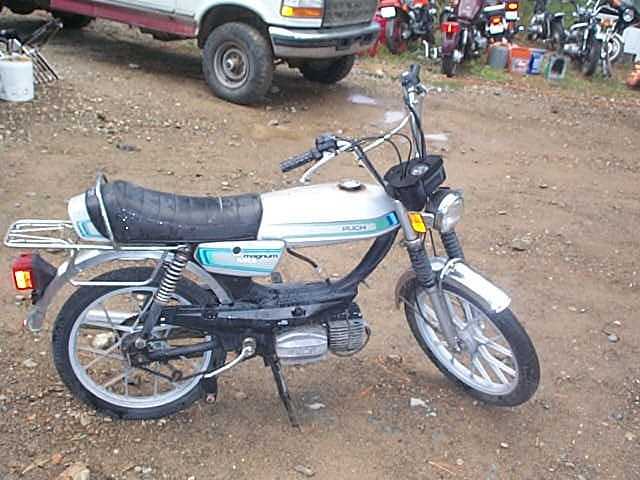
But I love two wheeled vehicles. I can't remember when I rode my first bicycle, but I remember my first moped ride very clearly. It was David (blank)'s moped and it looked a little like this:

I was 14 (legal age was 16) and heck it was a lot of fun. I had taken an interest in small engine repair when I was 12 or so and hated shoveling. We had an old snowblower that my father hadn't fixed because he would send me out to shovel. I learned to like earplugs, small engine repair, and running a snowblower far more fun than shoveling. My history coaxing life into small motors was traded for being able to frequently borrow the moped. Another friend also bought one so I often had access to one during high school.

But mopeds sort of suck. They are really heavy so most of the power is spent moving the frame around. Not to mention the Moped Hunch (TM). I'm 6'4" and mopeds aren't really customizable.
Ow. Look at that posture!
Soooo....

I have a bicycle I can no longer ride, the desire for another ridiculous project since my lathe now works again, and we just finished a release at work so I have a little free time to mess with.

Time to take this beauty and make it pedal itself.